
It’s sometimes said that inaction can be the best course of action. And as with many well-worn adages, there are many situations where it rings true.
For investors, being overly involved with your holdings by frequently buying, selling, or adjusting your strategy can often do more harm than good.
For example, you may be quick to sell in the face of volatility and miss the opportunity for your investments to recover when markets rebound. Equally, making frequent changes to your portfolio can lead to unnecessary transaction costs and potentially undermine the long-term strategy you have in place.
In many cases, maintaining a disciplined, long-term approach and allowing your investments time to grow can be more effective than trying to time the market. Of course, this doesn’t mean ignoring your portfolio altogether but rather reviewing it periodically to ensure it still aligns with your goals, time horizon, and attitude to risk.
Read on to find out why inaction can be just as important as action, and how it could help your investments grow.
Market dips are a regular feature of investing, and not reacting has historically led to a quicker recovery
When markets experience a downturn, your first instinct may well be to exit and cut your losses. But the reality is that markets regularly dip, and the path to recovery has historically been quicker if you remain invested and don’t react, rather than respond with a knee-jerk reaction.
For instance, figures from Vanguard tracked what would have happened to an investor’s portfolio if they cashed out during the recent dip in 2025 caused by the introduction of US trade tariffs, and then bought back into the markets once they had started recovering.
The data compares this with somebody who remained invested throughout. The results showed that cashing out, even for a short period, would have left you nearly 10% worse off, as shown in the graph below.
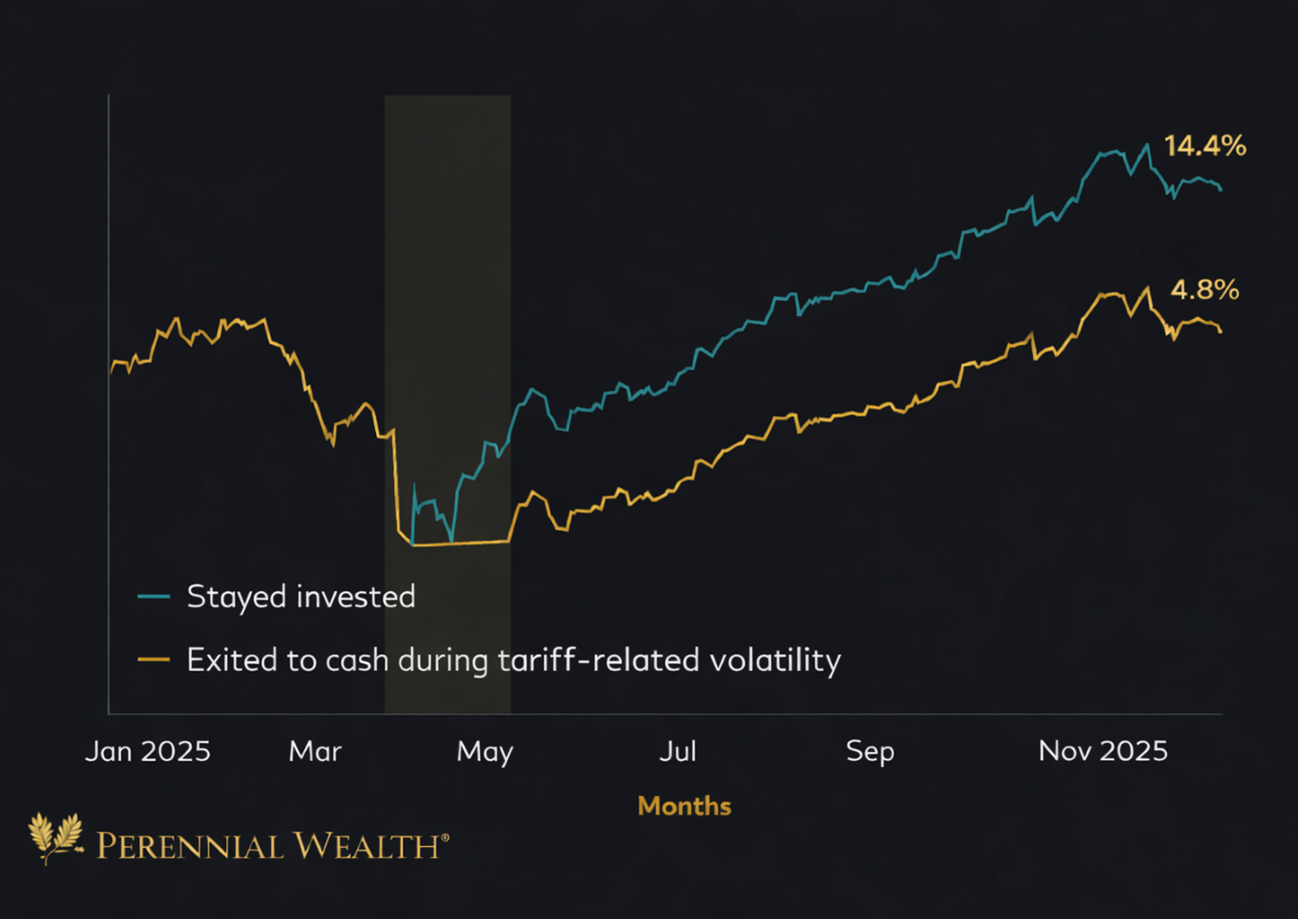
Source: Vanguard
As you can see, rushing into a decision and selling investments when markets fall, even if you quickly invest again, could hamper your returns.
Further research from Vanguard showed what the long-term effects of this could be. The data revealed that if you invested £100 in global shares at the start of 1975 and held them until May 2025, your portfolio would have been worth £29,307.
However, if you had exited the market every time it fell by 20% or more, and then re-entered after six months, your portfolio would have only grown to £15,663 in the same period.
These figures are based on historical returns from the MSCI World Total Return Index and MSCI AC World Total Return Index.
During these 50 years, there were countless global events, including the bursting of the dotcom bubble, the 2008 financial crisis, wars, elections, and a pandemic, all of which caused market dips. Despite this, holding your investments and not reacting would have been the most sensible course of action to help your portfolio recover any losses.
Overtrading can also have negative consequences for your portfolio
In addition to exiting during a downturn, trading too frequently can also be detrimental to your overall returns.
For instance, being overzealous with your actions can lead to higher transaction costs and fees, as moving your holdings often incurs charges that can add up over time.
Frequent trading can also increase the temptation to try to time the market and capitalise on short-term movements. However, this approach is extremely difficult to execute consistently and does not always lead to good outcomes – if it did, far more investors would be successful at it.
For example, research by Schroders found that if you invested £1,000 in shares in the UK’s 100 largest companies between 1988 and 2022, it would have grown to £15,104 if left untouched.
However, if you had attempted to time your entry and exit over that same period and missed just the 30 best market days as a result of poor timing decisions, the same investment might be worth around £3,100 today, £12,004 less.
There is also the gap between market performance and the returns investors actually achieve, often due to behavioural factors such as trying to time the market or reacting emotionally to short-term movements. You can read more about this in our previous article on the topic.
So, being overly eager to trade and react to short-term market movements can ultimately undermine your long-term returns. In many cases, remaining patient and sticking to a well-considered investment strategy can prove far more rewarding than trying to predict the market’s next move.
A strategy built around portfolio diversification, a long-term focus, and infrequent action often leads to more consistent outcomes
While you may think that being constantly involved with your investments is the best way to ensure they grow, the reality is often the opposite.
When markets dip, your investments typically have a better chance to recover if you avoid reacting impulsively, as you saw earlier. A well-diversified portfolio spread across regions, sectors, and asset classes can help weather challenging periods and reduce the temptation to make emotionally driven decisions.
Moreover, focusing on long-term, steady growth is usually a more effective approach than attempting to time the market. Short-term movements are unpredictable, and even experienced investors rarely get the timing consistently right.
So, whether it’s driven by fear of losses during volatility or an urge to capitalise on short-term opportunities, frequent intervention can often do more harm than good. Your portfolio is generally better served by taking a long-term approach built around diversification, with relatively little action required along the way.
Of course, there are some instances where adjustments may be appropriate, such as when your financial goals change, your time horizon shifts, or your portfolio needs to be rebalanced to maintain your desired level of risk. In most cases, however, patience, discipline, and a clear long-term strategy can be among the most valuable tools an investor has.
Get in touch
A well-structured financial plan can help you stay on track towards your long-term goals without the need for constant intervention.
To discuss your own planning, reply to this email or call the office on 0117 959 6499.
Risk warnings
This article is for general information only and does not constitute advice. The information is aimed at individuals only.
All information is correct at the time of writing and is subject to change in the future.
The value of your investments (and any income from them) can go down as well as up and you may not get back the full amount you invested. Past performance is not a reliable indicator of future performance.
Investments should be considered over the longer term and should fit in with your overall attitude to risk and financial circumstances.
This article does not constitute tax, legal or financial advice and should not be relied upon as such. Tax treatment depends on the individual circumstances of each client and may be subject to change in the future. For guidance, seek professional advice.
Approved by Best Practice IFA Group Limited on 16/03/2026