
If you’ve ever seen a large group of people gathered to look at something and then wandered over to find out what’s happening, you have exhibited traits of a common behavioural bias.
This particular bias, known as “herd mentality”, refers to the (very normal) human instinct to follow a crowd rather than ignore the pack and move as an individual.
While such biases can be incredibly useful in helping us survive, they can also negatively interfere with matters that require a less reactive response.
When it comes to investing, biases can have such an impact that there is even a name given to the difference between investor returns with and without interference: “the behaviour gap”.
Read on to find out more about the behaviour gap and how financial planning can help you overcome it.
The behaviour gap is connected to human survival instincts
The human brain has evolved to make instant decisions based on external stimuli that can help us survive.
Perhaps the best-known is the “fight-or-flight” response, which forces you to react quickly rather than a more measured one. It’s a stress response that kicks into action when we perceive danger or threat.
During market downturns, you might look at your investments and see significant losses. Because the brain processes losses as pain, its immediate reaction is to perceive a threat and trigger the fight-or-flight response.
This could then lead you to sell off during a short-term dip, which may mean you’re unable to recover your losses and benefit from the market’s long-term trend towards growth.
For example, global markets dipped significantly in April 2025 when Trump announced the US trade tariffs. However, by the middle of May, most markets had recovered and 2025 went on to be one of the strongest years for returns in the last decade.
Indeed, research by Schroders reveals that exiting the market after every big fall since the late 19th century would have meant a longer recovery time than if you’d remained invested.
Conversely, if there is a particularly high-performing stock, you may be tempted to follow the herd of investors all rushing to invest, but again, this hasn’t historically been a good idea.
Further analysis from Schroders found that in 12 of the 18 years between 2005 and 2022, not a single top-10 performing US stock also made the top 10 the next year. In five of the other six years, only one managed it, and in the final year, three did.
Moreover, an average of 15 companies a year managed to be in the top 100 for two consecutive years.
So, whether you are drawn to follow the herd and invest in the latest high performer or your stress response triggers a sell-off, giving in to biases based on short-term movements can detrimentally affect your investments.
The behaviour gap can lead to double-digit differences in returns
While the behaviour gap is most pronounced during periods of significant market volatility, it never truly goes away and can lead to a significant disparity in returns over time.
Barclays reports that the behaviour gap was 122 basis points a year in the decade up to December 2024, which would mean investors lost an average of 15% of total potential returns over the period.
The report goes on to cite academic studies that estimated the average investor’s behaviour gap is around 115 basis points a year.
So, if the average investor between 2014 and 2024 had not heeded their biases and had instead understood that long-term trends necessitate some volatility, their investments could be worth 15% more today.
Financial planning can help you overcome the behaviour gap
A financial planner can’t undo millions of years of evolution and rewire your behavioural biases.
However, they can create a structured plan that helps ensure you pause and reflect, rather than making quick decisions based on your short-term fears or excitement.
Volatility is a natural part of market movements, and even significant drops are typically followed by recovery. A financial planner understands this and can provide crucial insight and expertise during periods of uncertainty.
The graph below shows the growth of $1,000 invested in the US stock market from 1926 to 2024, mapped alongside significant market drops and periods of recession.
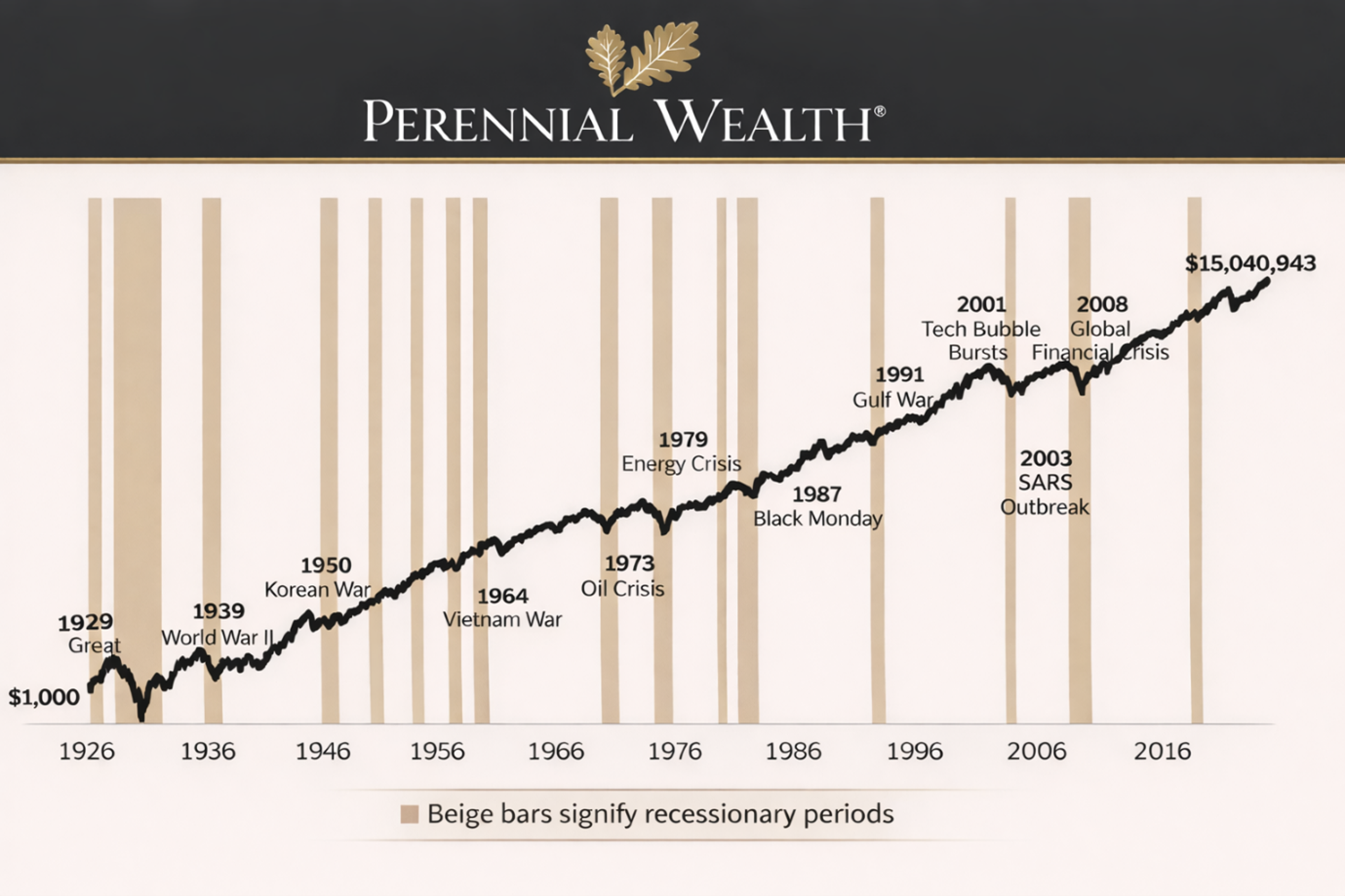
As you can see, despite significant downturns, the market’s trajectory over the past century has been towards growth. Had you listened to your behavioural biases and exited during any of the recessionary periods or dips, you would have missed out on the opportunity to recover your losses and benefit from long-term market growth.
A financial planner can work with you to understand your long-term goals and aspirations. They can then develop a plan tailored to you, built around what you want to achieve over your life, not just the next year or in a quick attempt to cut losses or make a seemingly good investment.
They can also help you diversify your investments to help smooth periods of volatility and fluctuations.
By understanding you and your goals, as well as long-term market trends, a financial planner can develop a plan that helps keep you focused on what matters, even when markets and emotions are pulling you in different directions.
To speak to a financial planner, get in touch.
Email info@perennialwealth.co.uk or call 0117 959 6499.
Risk warnings
This article is for general information only and does not constitute advice. The information is aimed at individuals only.
All information is correct at the time of writing and is subject to change in the future.
The value of your investments (and any income from them) can go down as well as up and you may not get back the full amount you invested. Past performance is not a reliable indicator of future performance.
This article does not constitute tax, legal or financial advice and should not be relied upon as such. Tax treatment depends on the individual circumstances of each client and may be subject to change in the future. For guidance, seek professional advice.
Approved by Best Practice IFA Group Limited on 12/02/2026